Monopoly Live Prediction: What Really Decides the Wheel Outcome
Every Monopoly Live session starts the same way — the host spins the wheel, and players try to guess where it stops. Naturally, the first question most people ask is: can the result be predicted? The short answer is no. But the longer answer involves physics, probability, and a few things worth knowing before you place another bet.
Can Anyone Predict Monopoly Live Results?
Search for "Monopoly Live predictor" and you'll find dozens of apps and websites claiming to forecast the next spin. Some show percentage bars. Some display fake algorithms running in real time. None of them work.
Here's why. Monopoly Live is hosted from a physical studio operated by Evolution. A real person spins a real wheel. The outcome depends on the force of the spin, air resistance, the weight of the flapper, and dozens of micro-variables that change every single round. There is no software algorithm deciding where the wheel lands — it's mechanical randomness, verified by independent testing labs like eCOGRA and GLI.
So-called predictor apps have no access to the studio feed mechanics. They generate random outputs dressed up as "AI predictions." Some are harmless gimmicks. Others are designed to harvest your data or push you toward unlicensed casinos. Either way, they don't predict anything.
How the Monopoly Live Wheel Is Built
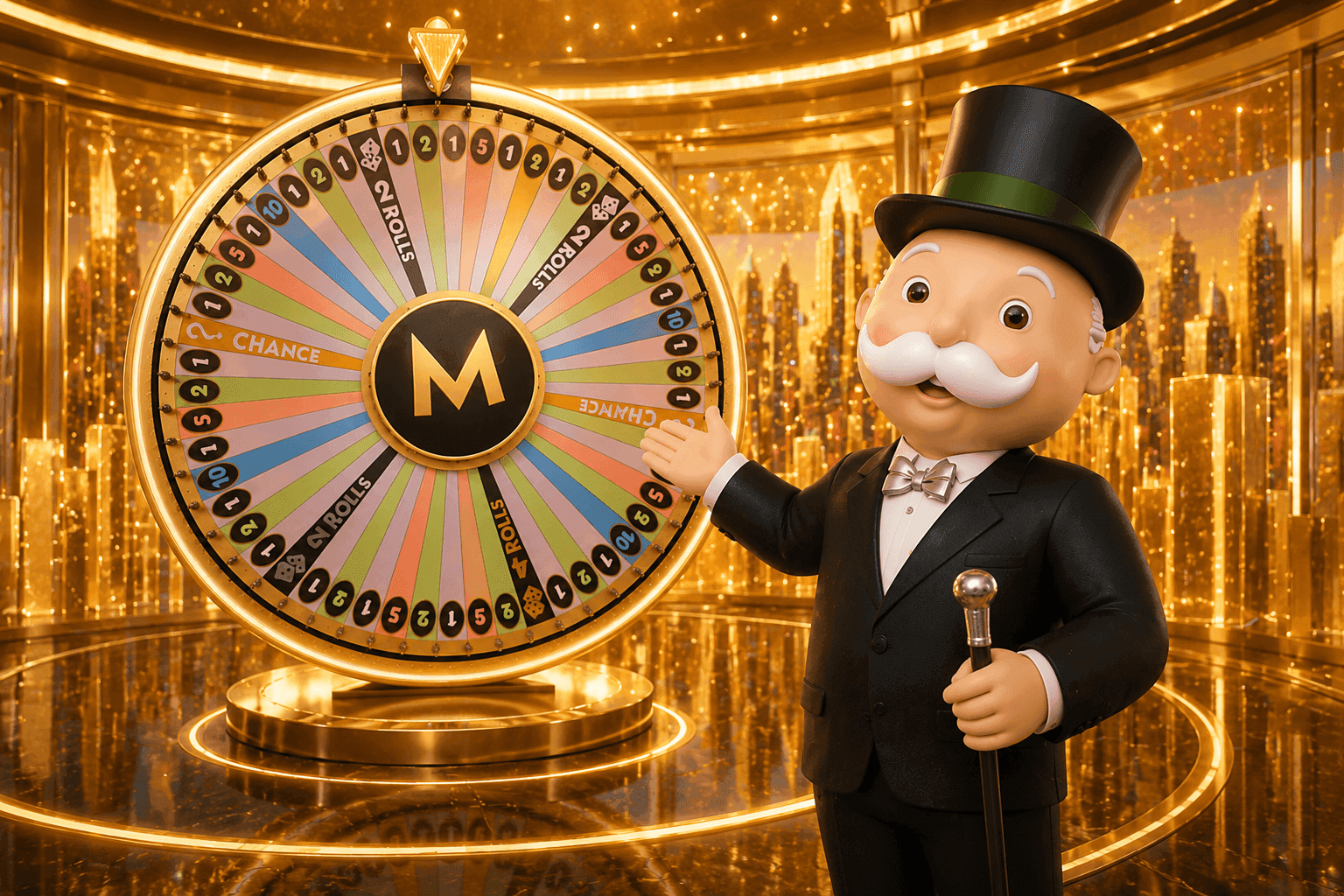
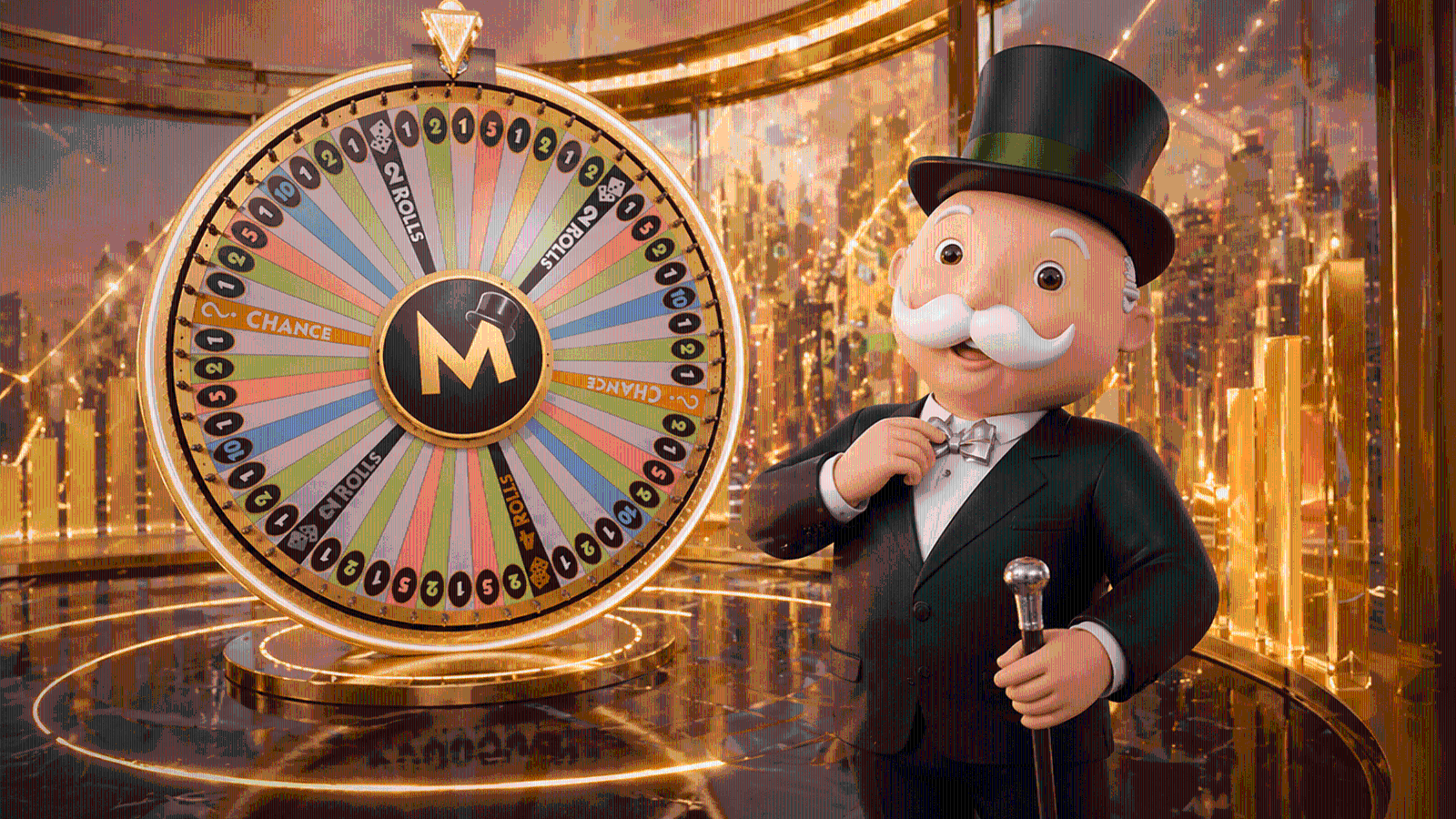
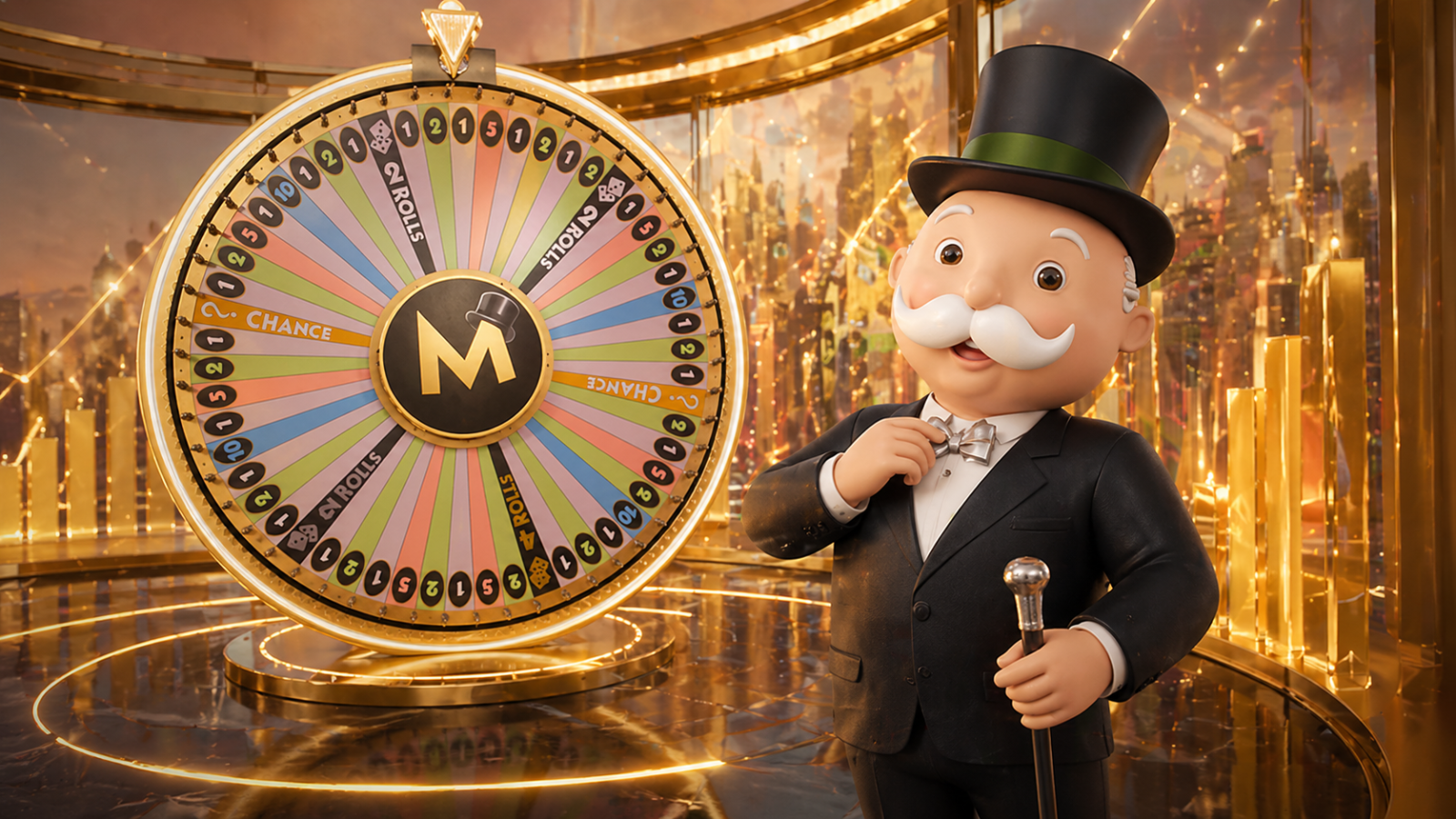
The wheel has 54 segments in total. Each segment corresponds to a specific outcome, and the distribution is not equal — which is exactly what creates the odds.
Here is the exact layout:
| Segment | Count | Share of Wheel |
|---|---|---|
| 1 | 22 | 40.7% |
| 2 | 15 | 27.8% |
| 5 | 7 | 13.0% |
| 10 | 4 | 7.4% |
| CHANCE | 2 | 3.7% |
| 2 ROLLS | 3 | 5.6% |
| 4 ROLLS | 1 | 1.9% |
Twenty-two out of fifty-four segments are "1." That means in roughly 4 out of every 10 spins, the wheel lands on the lowest payout. Meanwhile, there is only one single segment for 4 ROLLS — making it the rarest outcome on the board.
This distribution isn't random. It's engineered to create a specific house edge while keeping every spin unpredictable.
What Happens During 2 ROLLS and 4 ROLLS
These are the bonus rounds that make Monopoly Live different from a standard money wheel.
When the wheel lands on 2 ROLLS, a 3D Monopoly board appears. Mr. Monopoly rolls the dice twice. Each square he lands on has a multiplier attached — anywhere from 1x to several hundred. Whatever multiplier he ends up on gets applied to your bet.
Evolution caps the maximum payout at 10,000× your total bet per round. The 4 ROLLS bonus is the only path that can realistically approach this ceiling — and even then, it requires consecutive high-multiplier properties and no tax squares along the way.
The CHANCE segments work differently. They can award either a random cash prize or a random multiplier applied to the next spin. They add another layer of variance to each session.
Monopoly Live Odds and RTP
Every segment has a theoretical Return to Player (RTP) value. This is the percentage of total bets that the game returns to players over millions of spins.
| Bet Type | Theoretical RTP |
|---|---|
| 1 | 92.88% |
| 2 | 95.19% |
| 5 | 91.30% |
| 10 | 95.98% |
| CHANCE | 93.90% |
| 2 ROLLS | 93.60% |
| 4 ROLLS | 93.67% |
A few things stand out. Betting on 10 gives you the highest RTP at nearly 96%. Betting on 5 has the lowest at 91.3%. The bonus rounds (2 ROLLS, 4 ROLLS) sit in the middle — they're exciting, but they don't actually offer better mathematical value than a simple bet on 10.
Overall game RTP hovers around 91.30% to 95.98% depending on your betting pattern. This means for every $100 wagered across many sessions, you can expect to get back roughly $91–$96 on average.
Why Patterns Don't Mean What You Think
After watching Monopoly Live for a while, you'll start noticing things. "It hasn't landed on 4 ROLLS in 200 spins." "Number 1 came up five times in a row." Your brain wants to find a pattern and use it to predict what comes next.
This is the gambler's fallacy. Each spin is independent. The wheel has no memory. If 1 has landed ten times in a row, the probability of it landing on 1 next spin is still exactly 40.7%. Previous results don't shift future odds.
Trackers and history boards in the game interface show past results for entertainment, not because they contain actionable data. They create the illusion of pattern where only randomness exists.
What You Can Actually Control
You can't predict the wheel, but you can make informed decisions about how you play:
Bet selection matters. Betting on 10 gives you the best RTP. Betting on 5 gives you the worst.
Bankroll management matters. Deciding in advance how much you're willing to spend — and stopping when you reach that limit — is the only reliable "strategy" in any game of chance.
Watching before playing helps. You can observe the game in spectator mode to understand the pace, the bonus round frequency, and the general feel before committing real money. This won't improve your odds, but it will improve your comfort level.
If you want to explore betting approaches in more detail, check out our strategy breakdown. For watching the game without risking money, try the demo mode. And if you're looking for the best welcome offers to start with, see our bonus overview.